Encoder Calibration Guide
Why Calibration Is Necessary for Measuring Equipment
Each measuring instrument and inspection device is made up of many precision components, and those components can slightly expand or contract due to changes in the environment, such as temperature and humidity.
As these small changes accumulate over time, they can affect measurement performance and appear as deviations from the true value, in other words, as measurement error.
To check whether this error exists and to what extent, regular inspection is required.
With long-term use, various parts can deteriorate and may no longer indicate the correct value.
Even if there is no obvious failure and the device is still operating, accurate measurement may not be possible if adjustment has shifted or if the measuring section has worn due to contact.
That is why calibration of measuring equipment is necessary.
Calibration is the process of verifying whether the actual unit in use is measuring correctly.
The measured value of the actual unit is compared with that of a reference standard to identify any difference or deviation.
If calibration shows that adjustment is necessary, repair or maintenance will be carried out.
If measuring equipment cannot measure correctly, product quality cannot be maintained.
Even if a product passes inspection in-house, if it is judged defective at the customer’s incoming inspection, it can seriously damage the company’s credibility.
By maintaining measurement accuracy through regular calibration, the quality of your own products is indirectly assured.
Calibration of measuring equipment is therefore an essential task that must not be overlooked in manufacturing.
Please note that calibration and repair are not the same thing.
You can think of calibration as a regular health check, and repair as treatment. They are separate services.
If any problem is found in a product sent to us for calibration, we will contact you at that stage to confirm whether you would like us to repair it or return it as is.
Please note in advance that any such cost will be billed separately from the issuance of the calibration certificate.
When Should Calibration Be Performed?
There is no single fixed rule for when calibration work should be performed or how often it should be done.
Under ISO 9001, in the section on control of monitoring and measuring equipment, it is stated that calibration should be performed at specified intervals or prior to use, and that it should be carried out against measurement standards traceable to international or national measurement standards. However, the specific calibration interval itself is not defined.
In our case, we recommend calibration every 1 to 2 years.
If power is continuously applied, light output may degrade by about 10% over 3 to 5 years, so if you want to be especially cautious, we recommend replacing the product after about 5 years.
If the equipment is used frequently and for products with strict accuracy requirements, safety and quality must be assured.
It is important to determine an appropriate interval that can be judged acceptable for your own product quality control, while taking into account usage frequency, operating environment, labor, personnel, and cost.
About the Calibration Certificate Issued After Calibration
Calibration of measuring equipment is not sufficient simply because it has been performed. It is important to show evidence that the calibration result is valid.
If the validity of the calibration result cannot be demonstrated, quality assurance cannot be supported.
The following points are required for calibration to be externally recognized as valid.
・Calibration is carried out regularly by qualified calibration personnel
・Traceability of the reference standard used for calibration is established
・The procedure is clearly defined in a written procedure document
・There is a record proving that calibration was performed
Documents are available to prove that calibration work meeting the above requirements has been carried out.
The calibration-related documents we issue include the calibration certificate, inspection report, and traceability system chart.
Sample Documents
(The samples are blurred for illustration purposes.)
Calibration Certificate
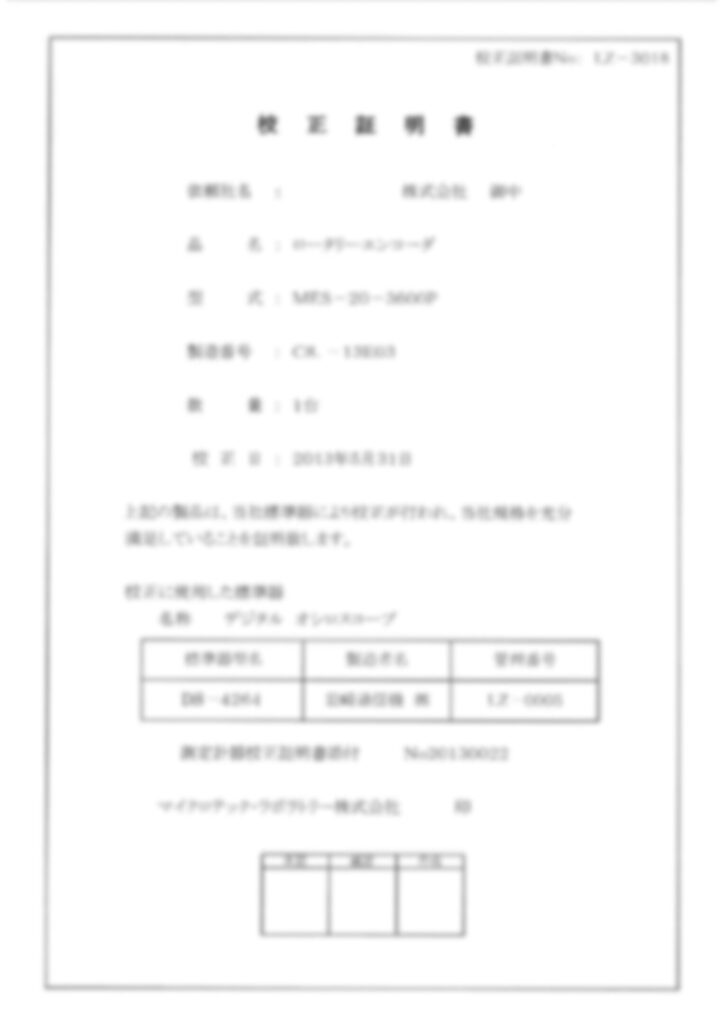
●This document shows the calibration results of the measuring equipment.
It includes the date of calibration, the name of the manufacturer that performed the calibration,
the serial number, inspection results, and other relevant information.
Inspection Report
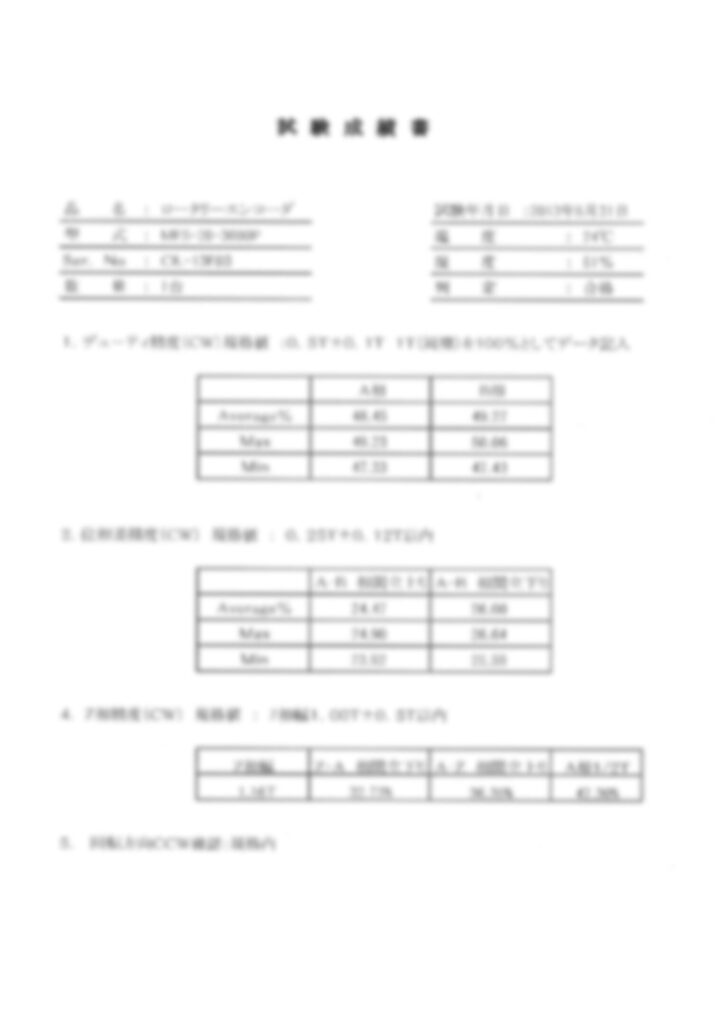
●This document records and summarizes the results of internal inspections carried out by Microtech Laboratory.
It clearly states the measured and confirmed results, based on our in-house standards, for inspection items related to key product dimensions, performance, appearance, and more.
Traceability Certificate

●The traceability system chart is a document that shows the calibration route of the equipment used for calibration.
By tracing the chain upward, it clarifies what standards were used to perform the calibration.
To satisfy the calibration requirements of ISO 9001, the reference standard used for comparison during calibration must be traceable to international or national measurement standards.
It is documented in a way that shows that, when traced to the top level, it reaches international or national measurement standards.
Calibration Document Availability Table
| Calibration Certificate | Inspection Report | Traceability Certificate | |
| Incremental Encoder | ○ | ○ | ○ |
| Wire Incremental | ○ | ○ | ○ |
| Roller Encoder | ○ | ○ | ○ |
| Parallel Absolute | ○ | ○ | ○ |
| Serial Absolute | × Not supported | ○ | ○ |
| Wire Absolute | ○ | ○ | ○ |
Questions About Calibration Requests
Q1. What should I do if I want to calibrate a product after purchase?
If calibration cannot be performed due to poor accuracy or other issues, please consult separately with the person in charge. [Microtech Laboratory Co., Ltd. Machida Factory] 3-20-28 Asahi-cho Machida-shi, Tokyo 194-0023 042-746-0123 Sales Department
Is there any guideline or method for using encoders with confidence?
[Regarding service life] The design service life depends on your operating environment and is mainly affected by aging deterioration of the LED or bearings. [Recommended replacement timing] Our recommendation is every 2 years. Please note that this is not a general guideline for all products, since it depends on the operating environment. It is affected by operating temperature and energizing time, but if power is continuously applied, light output may degrade by about 10% over 3 to 5 years. This is still within a range that does not cause any performance issue, but if you replace the product or request calibration after 1 to 2 years, you can maintain highly reliable performance.
Other Documents
For requests to issue documents other than calibration-related documents, please contact us through the inquiry form.