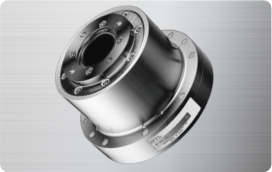
Vacuum-Compatible Direct Drive Motor
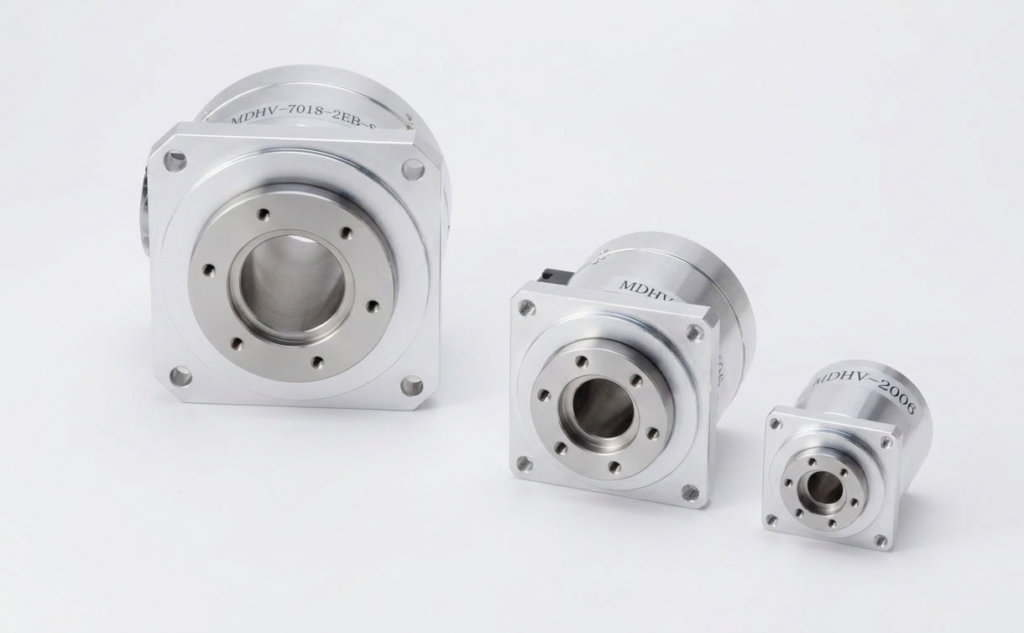
Vacuum-Compatible μDD Motor Under Development
Microtech Laboratory Co., Ltd. is developing a compact, hollow-shaft, vacuum-compatible direct drive motor for precision rotary motion inside vacuum chambers.
The motor is being developed for semiconductor equipment, vacuum systems, analytical instruments, and other applications that require accurate positioning, clean operation, and a compact mechanical structure.
By driving the load directly without gears or belts, the μDD Motor eliminates backlash from transmission components and reduces the number of mechanical parts required around the rotary axis.
Product status: This vacuum-compatible μDD Motor is currently under development. Final specifications and availability may vary by model and application.
Targeting Operation in High Vacuum at 10⁻⁴ Pa
The motor is being designed to operate in a high-vacuum environment at approximately 10⁻⁴ Pa.
The development objective is stable positioning and rotary motion inside vacuum equipment without adversely affecting the required vacuum conditions.
Final operating limits will depend on the motor configuration, load, rotational speed, duty cycle, thermal conditions, installation method, and surrounding vacuum system.
Low-Outgassing Design for Vacuum Chambers
Material selection and structural design are being reviewed to reduce outgassing from the motor inside the vacuum chamber.
This development approach is intended to help maintain vacuum quality and reduce contamination risks in processes where molecular contamination must be carefully controlled.
The final outgassing performance will be defined according to the applicable motor model, operating conditions, evaluation method, and customer requirements.
Low Particle Generation for Clean Processes
Particle generation during motor operation is also being evaluated as part of the development process.
The development target is a particle generation level corresponding to the legacy US FED STD 209E Class 10 reference under defined test conditions.
Because particle performance depends on the particle size, measurement method, rotational speed, load, operating time, and installation environment, the applicable test conditions and measured results must be confirmed for the final product.
Compact Hollow-Shaft Direct Drive Structure
The vacuum-compatible μDD Motor is being developed with a compact hollow-shaft structure.
Depending on the final model and application, the hollow shaft can support the routing of cables, optical paths, tubes, or other components through the center of the rotary axis.
The direct drive structure also removes the need for a separate gearbox, timing belt, or transmission mechanism, helping simplify the design of compact vacuum-compatible rotary modules.
Potential Applications
- Rotary axes inside vacuum chambers
- Semiconductor process and inspection equipment
- Vacuum-compatible positioning stages
- Analytical and measurement instruments
- Optical alignment and precision rotation systems
- Research and development equipment operating under vacuum
Application suitability must be confirmed according to the required vacuum level, torque, speed, positioning performance, allowable temperature, particle requirements, and installation conditions.
Information Required for Motor Selection
To review whether the vacuum-compatible μDD Motor can be used in your equipment, please provide the following information:
- Required vacuum pressure
- Required torque and rotational speed
- Load inertia and motion profile
- Required positioning accuracy and repeatability
- Required hollow-shaft diameter
- Operating temperature and duty cycle
- Particle and outgassing requirements
- Installation space and dimensional restrictions
- Required encoder and control interface
- Target development and production schedule
Related μDD Motor Information
Learn more about the structure and operating principles of MTL’s compact direct drive motors:
Discuss Your Vacuum Motor Application with MTL
Please contact MTL with your required vacuum level, motion specifications, installation conditions, and target schedule. Our sales engineering team will review the application and provide information about the current development status.